Showing posts with label ROBYN HITCHCOCK. Show all posts

Wednesday, September 15, 2010

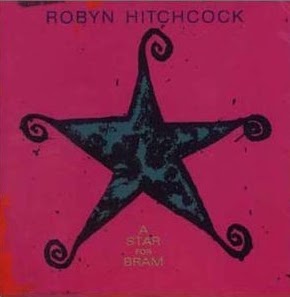
50. A Star for Bram


50. A Star for Bram, Robyn Hitchcock (Editions PAF!, 2000)

The Aughts began slowly for veteran British songwriter Robyn Hitchcock.  His Warner Bros. contract ended after three albums (including Mossy Liquor, the vinyl-only companion piece to his Moss Elixir album, both ’96), leaving him without major-label support for the first time since ’86.  Between ’00 and ’03 he quietly issued three albums on his own Editions PAF! label.  This trio included Robyn Sings, a live double album composed entirely of Bob Dylan covers, much of which had previously appeared as an extended appendix to the Warner-issued, promo-only ’97 single for his song Beautiful Queen.  The recycling of promo-only B-sides following the loss of a contract might seem an inauspicious move, were the performances not strong, sought-after material likely rejected for full release by Warner.  Two years before Robyn Sings, though, slipped another unusual album, A Star for Bram.  Released “under special license from Warner,” it arrived with the feel of a fan-club album and cover art almost replicating that of Jewels for Sophia (’99), his final Warners album.  Often diminished as a mere collection of Sophia outtakes, Bram indeed includes two songs that appeared on the Warner-issued, Sophia-supporting promotional EP entitled Rare Jewels.  While the Aughts would be Hitchcock’s most prolific decade, A Star for Bram was just one of a string of albums from the decade comprising outtakes, old material, or other oddities while masquerading as new releases.  A Star for Bram is unique among its colleagues, however, as it is arguably stronger than any of the four “real” new LPs that Hitchcock issued in the Aughts.

Bram is a tempered, darker sibling to Jewels for Sophia.  The Warner album is bright, often raucous, and comical; one can almost imagine a Warner executive opting against Bram’s less immediate songs and saying, “We want the funny songs, the ones where you talk about vegetables a lot.”  While the two albums’ most haunting song (No, I Don’t Remember Guildford) does appear on Sophia and Bram is not devoid of levity, Bram is the more subdued record.  It opens with two understated acoustic numbers; the second, the gently shimmering I Saw Nick Drake, is like a transcription of a dream, with Hitchcock meeting the long-dead British folksinger, doing chores together, and interacting in the surreal ways that only the subconscious can manifest; it is built on a transfixing repeated guitar figure and joined by Hitchcock’s highly reverbed wordless humming between the verses.  Judas Sings (Jesus and Me) and I Used to Love You are both stripped-down ballads, the latter using only voice and piano.  Bram’s electric numbers outnumber the unplugged entries, but these, too, are largely subdued.  A minimal, sax-tinted groove supports the skeletal boogie of Adoration of the City; the mild skiffle of The Philosopher’s Stone features just Jon Brion and Hitchcock, the latter adding melodic accents with a “harmony machine.”  The record’s two expository highlights are Nietzsche’s Way, its title punning on Spirit’s 1970 song Nature’s Way, and a new studio recording of Hitchcock’s nostalgic travelogue 1974, which previously appeared on the ’98 in-studio live soundtrack Storefront Hitchcock.  A final thread connecting the album to Jewels for Sophia is a dub version of that album’s Antwoman that gives the lilting original an ominous tint.  Hitchcock’s departure from the major-label system may have resulted in a circuitous new pattern of record-making, but as long as his catalog continues to generate albums as reliable as A Star for Bram it will be worth following.

Highlights: 1974, Daisy Bomb, Nietzsche’s Way, I Saw Nick Drake

Sublime bit: Those spectral, wordless choruses of I Saw Nick Drake.

Read the NOYOUCMON mission statement here.

Sunday, July 4, 2010

61. Olé! Tarantula


61. Olé! Tarantula, Robyn Hitchcock and the Venus 3 (Yep Roc, 2006)

London-born songwriter Robyn Hitchcock has maintained a prolific solo career since leaving new-wave psych-poppers the Soft Boys in 1980.  Issuing some three dozen albums, half of those being studio efforts and the rest comprising outtakes, radio sessions, live gigs, and revisitings of old work, Hitchcock has developed a devoted following while consistently delivering engaging new material.  A certified English eccentric, Hitchcock built a reputation for unorthodox lyrics about vegetables, insects, and other such matter, though it is unfair to categorize him as a strict humorist or capable only of idiosyncratic composition.  His quick-witted, picturesque writing makes him a natural descendant of influences Bob Dylan and John Lennon, and he has a knack for fragile beauty as much as for spirited, assertive pop music.  While he began the Aughts with a dismissal from Warner Bros., leaving him without a major-label deal for the first time since the late Eighties, it would be his most prolific decade, producing six studio albums, another six of live material and/or outtakes, two comprehensive box sets of his ’80s solo work, as well as a Soft Boys reunion album, accompanying EP, and an exhaustive reissue of their ’80 LP Underwater Moonlight.

Hitchcock’s ’06 studio album Olé! Tarantula, his sixteenth not counting Soft Boys material, finds him recording with a dedicated group for the first time since the ’93 disbanding of his backing group the Egyptians.*  The Venus 3 features several well-known Seattle-based musicians: longtime collaborator Peter Buck on guitar, R.E.M. touring drummer Bill Rieflin (also late of numerous industrial groups including Ministry, KMFDM, and Pigface), and Scott McCaughey of the Young Fresh Fellows and the Minus 5 (the latter of which has also included Rieflin).  The album also features among its numerous guest spots contributions from former Soft Boys Kimberley Rew and Morris Windsor.  Most of Hitchcock’s previous Aughts work is reserved, acoustic music; stripped-down records like Luxor (’03) and Spooked (’04, his first on now-longtime label Yep Roc) are enjoyable, but are not among his most memorable efforts.  Olé! Tarantula is, conversely, his most electrified album since his work with the Egyptians.  It opens with two numbers that recall the finest of his ’80s pop heyday.  The hard-edged Adventure Rocket Ship juxtaposes a yearning lover with cosmic detritus like “skeletons of spacemen” and time-warp romance (“I kiss you in the past”); next is Underground Sun, a summery pop blast whose sound masks its lyric about a deceased friend (“You lie so lonely/Listening to the silence of the graves/You don’t belong there/You belong down south among the waves”).  A third pop blowout comes with ’Cause It’s Love (Saint Parallelogram), written with reclusive XTC frontman Andy Partridge yet unfortunately not boasting a guest appearance from its co-author.  Reprised from the Japan-only ’05 odds-and-ends LP Obliteration Pie is (A Man’s Gotta Know His Limitations) Briggs; despite a new arrangement with an incongruous synth line, the Tarantula version remains an album highlight.  The album’s closing song is its most haunting; N.Y. Doll is a moving account of the troubled last years of New York Dolls bassist Arthur Kane.  Olé! Tarantula is a contender for Hitchcock’s best work of the decade; those craving more should seek out its companion EP Sex, Food, Death...and Tarantulas, which features live versions of Briggs and five other tunes from Hitchcock’s deep catalog.

* Or fifteenth, to those who insist on categorizing his 2000 LP A Star for Bram as a mere set of outtakes from the '99 Jewels for Sophia album.  I maintain otherwise.

NOTE: As a proponent of wax, it pains me when I cannot recommend a vinyl pressing of an album; however, the vinyl pressings produced by Yep Roc are routinely substandard.  Overzealous bass response, muddy mastering, and general poor fidelity render this label's releases best purchased on the compact disc format.  I've heard both versions of Olé! Tarantula, and the CD trounces the vinyl version.  If you do not care about fidelity, purchase a download of this album.  The vinyl receives a NOYOUCMON "do not buy" warning.

Highlights: Underground Sun, Adventure Rocket Ship, N.Y. Doll, (A Man’s Gotta Know His Limitations) Briggs

Sublime bit: Underground Sun’s pulsing bridge (“One for the girl who went away/Two for the girl that went astray/Three is in between you”).
 
Read the NOYOUCMON mission statement here.