Showing posts with label ROCK. Show all posts

Friday, November 7, 2025

26. Bachelor No.2


26. Bachelor No. 2, Aimee Mann (SuperEgo, 2000)

This is a placeholder for an entry to come in my Top 125 Albums of the 2000s, which I selected at the end of 2009. This blog has been dormant since autumn 2010, and my intention is to finish the final 45 entries as originally selected despite the distant vantage point and my opinions having changed in the interim. 

Read the NOYOUCMON mission statement here


28. The Real New Fall LP (Formerly 'Country on the Click')


28. The Real New Fall LP (Formerly 'Country on the Click'), The Fall (UK version) (Action, 2003)

This is a placeholder for an entry to come in my Top 125 Albums of the 2000s, which I selected at the end of 2009. This blog has been dormant since autumn 2010, and my intention is to finish the final 45 entries as originally selected despite the distant vantage point and my opinions having changed in the interim. 

Read the NOYOUCMON mission statement here

29. Set 'em Wild, Set 'em Free


29. Set 'em Wild, Set 'em Free, Akron/Family (Dead Oceans, 2009)

This is a placeholder for an entry to come in my Top 125 Albums of the 2000s, which I selected at the end of 2009. This blog has been dormant since autumn 2010, and my intention is to finish the final 45 entries as originally selected despite the distant vantage point and my opinions having changed in the interim. 

Read the NOYOUCMON mission statement here

30. XTRMNTR


30. XTRMNTR, Primal Scream (Creation UK 2000, Astralwerks US 2000)

This is a placeholder for an entry to come in my Top 125 Albums of the 2000s, which I selected at the end of 2009. This blog has been dormant since autumn 2010, and my intention is to finish the final 45 entries as originally selected despite the distant vantage point and my opinions having changed in the interim. 

Read the NOYOUCMON mission statement here


Thursday, November 6, 2025

31. Dig, Lazarus, Dig!!!


31. Dig, Lazarus, Dig!!!, Nick Cave and the Bad Seeds (Mute UK 2008, Anti- US 2008)

This is a placeholder for an entry to come in my Top 125 Albums of the 2000s, which I selected at the end of 2009. This blog has been dormant since autumn 2010, and my intention is to finish the final 45 entries as originally selected despite the distant vantage point and my opinions having changed in the interim. 

Read the NOYOUCMON mission statement here


33. Private Suit


33. Private Suit, Bettie Serveert (Palomine/PIAS Benelux 2000, Hidden Agenda/Palomine US 2000)

This is a placeholder for an entry to come in my Top 125 Albums of the 2000s, which I selected at the end of 2009. This blog has been dormant since autumn 2010, and my intention is to finish the final 45 entries as originally selected despite the distant vantage point and my opinions having changed in the interim. 

Read the NOYOUCMON mission statement here


35. This Night

35. This Night, Destroyer (Scratch Canada 2002; Merge US 2002)

This is a placeholder for an entry to come in my Top 125 Albums of the 2000s, which I selected at the end of 2009. This blog has been dormant since autumn 2010, and my intention is to finish the final 45 entries as originally selected despite the distant vantage point and my opinions having changed in the interim. 

Read the NOYOUCMON mission statement here


Wednesday, November 5, 2025

36. Cold War Classic

36. Cold War Classic, The Chrysler (Flora & Fauna Sweden 2005; Galaxy Gramophone/Parasol US)

This is a placeholder for an entry to come in my Top 125 Albums of the 2000s, which I selected at the end of 2009. This blog has been dormant since autumn 2010, and my intention is to finish the final 45 entries as originally selected despite the distant vantage point and my opinions having changed in the interim. 

Read the NOYOUCMON mission statement here

37. Merriweather Post Pavilion


37. Merriweather Post Pavilion, Animal Collective (Domino, 2009)

This is a placeholder for an entry to come in my Top 125 Albums of the 2000s, which I selected at the end of 2009. This blog has been dormant since autumn 2010, and my intention is to finish the final 45 entries as originally selected despite the distant vantage point and my opinions having changed in the interim. 

Read the NOYOUCMON mission statement here.


39. The Decline of British Sea Power


39. The Decline of British Sea Power, British Sea Power (Rough Trade, 2003)

This is a placeholder for an entry to come in my Top 125 Albums of the 2000s, which I selected at the end of 2009. This blog has been dormant since autumn 2010, and my intention is to finish the final 45 entries as originally selected despite the distant vantage point and my opinions having changed in the interim. 

Read the NOYOUCMON mission statement here.


40. Is a Woman


40. Is a Woman, Lambchop (Merge, 2002)

This is a placeholder for an entry to come in my Top 125 Albums of the 2000s, which I selected at the end of 2009. This blog has been dormant since autumn 2010, and my intention is to finish the final 45 entries as originally selected despite the distant vantage point and my opinions having changed in the interim. 

Read the NOYOUCMON mission statement here.


41. Vampire Weekend


41. Vampire Weekend (XL, 2008)

This is a placeholder for an entry to come in my Top 125 Albums of the 2000s, which I selected at the end of 2009. This blog has been dormant since autumn 2010, and my intention is to finish the final 45 entries as originally selected despite the distant vantage point and my opinions having changed in the interim. 

Read the NOYOUCMON mission statement here.

42. Love and Theft


42. Love and Theft, Bob Dylan (Columbia, 2001)

This is a placeholder for an entry to come in my Top 125 Albums of the 2000s, which I selected at the end of 2009. This blog has been dormant since autumn 2010, and my intention is to finish the final 45 entries as originally selected despite the distant vantage point and my opinions having changed in the interim. 

Read the NOYOUCMON mission statement here.

Tuesday, November 4, 2025

43. Clap Your Hands Say Yeah

43. Clap Your Hands Say Yeah (self-released, 2005)

This is a placeholder for an entry to come in my Top 125 Albums of the 2000s, which I selected at the end of 2009. This blog has been dormant since autumn 2010, and my intention is to finish the final 45 entries as originally selected despite the distant vantage point and my opinions having changed in the interim. 

Read the NOYOUCMON mission statement here.


44. The Dirty South


44. The Dirty South, Drive-By Truckers (New West, 2004)

This is a placeholder for an entry to come in my Top 125 Albums of the 2000s, which I selected at the end of 2009. This blog has been dormant since autumn 2010, and my intention is to finish the final 45 entries as originally selected despite the distant vantage point and my opinions having changed in the interim. 

Read the NOYOUCMON mission statement here

45. You Are the Quarry


45. You Are the Quarry, Morrissey (Attack/Sanctuary, 2004)

This is a placeholder for an entry to come in my Top 125 Albums of the 2000s, which I selected at the end of 2009. This blog has been dormant since autumn 2010 and my intention is to finish the final 45 entries despite the distant vantage point and my opinions having changed in the interim.

Read the NOYOUCMON mission statement here.

Sunday, November 28, 2010

46. Let It Come Down


46. Let It Come Down, Spiritualized (Arista, 2001)

Spiritualized, formed by members of Spacemen 3 after that group’s dissolution and led by Jason “Spaceman” Pierce, spent most of the Aughts in the shadow of their third album and masterpiece, Ladies and Gentlemen We Are Floating in Space (’97).  A natural progression from the opiated space-rock of the group Pierce led with Peter “Sonic Boom” Kember from ’82-’89, Spiritualized evolved beyond the majestically blunted grasps for sun-kissed ecstasy of its first two LPs for the sprawling sonic palette filtered through American blues and jazz forms of the monolithic Ladies and Gentlemen.  While Lay Back in the Sun from second album Pure Phase (’95) serves as the definitive exaltation of hedonism, Ladies and Gentlemen lyrically focuses on heartbreak and how to numb its pain—one of hedonism’s darkest sides.  The inclusion of horns, strings, and a choir sublimely embolden the effects-heavy arrangements.  The album received a deluxe reissue in ’09, the only Spiritualized release to earn such a treatment in the Aughts.  With the attention lavished on Ladies and Gentlemen between its release and reissue, it was easy to overlook the three studio albums released by Spiritualized during the decade.

Pierce fired several members after the release of Ladies and Gentlemen; by the time of Let It Come Down four years later, the group had been almost entirely rebuilt to include two former players from Julian Cope’s backing band.  Though his band now barely resembled its first incarnation, Pierce’s lyrical themes of freedom, catharsis, and ascension remained present.  Let It Come Down nakedly examines the dichotomy between flesh and salvation.  It opens with a ragtime piano frill and Pierce singing, “Let’s see how high we can fly/Before the sun melts the wax in our wings”; this icarian dare, repeated elsewhere, is an apt metaphor for the wantonness examined therein.  Though the habits outlined are excessive, they accompany idleness: “I’m planning on sleeping my life away” (Do It All Over Again); “I like to sit around/I’m just contemplating/sittin’ round” (Don’t Just Do Something); in The Twelve Steps, steps nine to eleven are simply staying in bed.  Excess is celebrated most explicitly in this last song—a frantic rock blast startlingly different than the album’s several purely orchestral arrangements—which states bluntly, “The only time I’m drink and drug free/Is when I don’t have to pay for what I need.”  The album’s side breaks emphasize the pattern of repeated abuse: side one, ambivalent laziness, likely hungover; a return to excess on side two; side three, its impact on loved ones; side four, Pierce’s pleas to God for salvation.  The yearning for religious epiphany is mocked (“I don’t think I’m gonna find Jesus Christ/So I’d rather spend my cash on vice,” The Twelve Steps), wistfully discarded (“If Jesus is the straight path that saves/Then I’m content to live my whole life on the curb,” The Straight and the Narrow), and, on the final two songs, desperately begged for.  Pierce originally performed the closing track, Lord Can You Hear Me, on the ’89 Spacemen 3 album Playing With Fire; here it is slower and bolstered by a gospel choir; Pierce’s repeated plea of “Lord can you hear me/Hear me at all?” makes for a compelling case that, despite earlier glibness, his pain is real and his torment about spirituality is no metaphor.  When he sings “The devil makes good use of these hands of mine” on The Straight and the Narrow, he sounds helpless yet resigned to his choices.  Let It Come Down suffered from the pressure of being the follow-up to a masterpiece, and is a denser, less immediate album, but perseverance reveals strengths that, in exposition and emotional impact, make it no less a stunning achievement.

Highlights: Do It All Over Again, The Straight and the Narrow, The Twelve Steps, Stop Your Crying

Sublime bit: The final two minutes of Lord Can You Hear Me, its arrangement swelling as Pierce and the choir plead for redemption.

Read the NOYOUCMON mission statement here.

Thursday, November 4, 2010

47. Hissing Fauna, Are You the Destroyer?


47. Hissing Fauna, Are You the Destroyer?, Of Montreal (Polyvinyl, 2007)

A person discovering Of Montreal via their breakthrough eighth LP Hissing Fauna, Are You the Destroyer? might not believe that they began as a lo-fi acoustic venture long on tedium and short on hooks.  Led by sole constant member Kevin Barnes, the Athens, Georgia-based group made five albums with ever-expanding lineups—’99’s The Gay Parade lists six full-time members and twelve contributors—before Barnes retreated to record two albums almost entirely by himself.  Satanic Panic in the Attic (’04) and The Sunlandic Twins (’05; see #68) were his strongest works to date, expanding on the earlier material’s fanciful concepts yet drab execution to produce a new sound flaunting complex, multi-tracked arrangements and borrowing heavily from ’60s-era psychedelic pop.  Though the albums became increasingly solo productions, the stage show evolved into a theatrical extravaganza with a dozen or more people on stage, usually in costume.  They managed to keep the spectacle from overpowering the music, and Barnes’s increasingly impressive songwriting and the band’s high-spirited performances made Of Montreal one of the most interesting working units of the late Aughts.

More compelling than the live show, though, is the density of Hissing Fauna’s songs in execution and lyrical content.  The quixotic, elaborate style of its two predecessors remains; but, the manic bubblegum of songs like Suffer for Fashion and Heimdalsgate Like a Promethean Curse are complemented by prominent servings of modern electro-funk.  Gronlandic Edit is built on a light, pulsing bass groove, and Bunny Ain’t No Kind of Rider has a slithering, smoky vibe; far beyond these dance-minded subtleties, though, is the flamboyance of Faberge Falls for Shuggie and Labyrinthian Pomp, both sung in an exaggerated, Prince-like falsetto that Barnes attributes to his alter ego Georgie Fruit, “a black man who has been through multiple sex changes.”*  While this persona affords Barnes’s lyrics a new aspect of sexuality, he uses no such guise to address the album’s most difficult material.  Much of Hissing Fauna is deeply personal, examining Barnes’s separation from his wife, a self-imposed temporary isolation in Norway, and reliance on antidepressants.  The album’s centerpiece is the twelve-minute The Past Is a Grotesque Animal, detailing the couple’s first meeting, courtship, and Barnes’s struggles with insecurity, progressing—all the while carried by a hypnotic, claustrophobic groove—to their tumultuous breakup; by its climax, Barnes is yelling “Let’s tear the fucking house apart/Let’s tear our fucking bodies apart!”  It is a chillingly naked dissection of private matters, intensified by the fact that the two reconciled and his wife plays on the album.  For all the costumes, playful gender experimentation, pop bliss, and jovial stage shows, the album often dares to forego metaphor to present some of the boldest self-analysis of the decade.  Barnes’s later attempts to outdo its ostentation and complexity resulted in a return to the muddled confusion of his earliest releases.  A dizzying album, at times even bipolar, Hissing Fauna is his high-water mark.

* See the November 2007 Barnes interview at http://pitchfork.com/features/interviews/7454-of-montreal/.

Highlights: The Past Is a Grotesque Animal, Heimdalsgate Like a Promethean Curse, She’s a Rejecter, Bunny Ain’t No Kind of Rider

Sublime bit: The “ooo-ooo-oooh” backing vocal that enters at 4:19 of The Past Is a Grotesque Animal and repeats for the next six minutes.

Read the NOYOUCMON mission statement here.

Friday, October 22, 2010

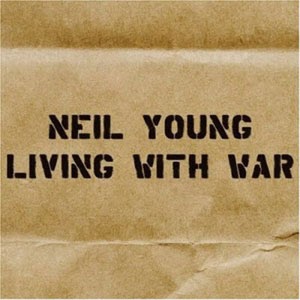
48. Living With War


48. Living With War, Neil Young (Reprise, 2006)

It was easy during the Aughts for even dedicated Neil Young fans to lose interest.  After his strong ’00 folk-rock outing Silver & Gold (see #75), Young released a stretch of work more ignominious than his much-maligned ’80s output.  The live Road Rock Vol. 1: Friends & Relatives (’00) was his fourth concert set in ten years, its arguable redundancy made worse by middling performances.  His long-awaited studio debut with Booker T. & the M.G.'s, Are You Passionate? (’02), was a passionless assortment of half-baked blues and painfully weak vocals; next came Greendale, a tedious 78-minute concept album short on melody that Young nonetheless felt warranted two separate editions.  During this parade of lackluster new material, Young waffled to the point of absurdity on his plans to release his long-promised Archives box set.  By the time the inoffensive but forgettable country-rock outing Prairie Wind arrived in ’05, NOYOUCMON had decided to retire from buying Neil Young albums.  Young’s next project proved so provocative, however, that even the most jaded fan was hard pressed to ignore it.  Angry to the point of despair about the seeming futility of the wars being fought in Afghanistan and Iraq, Young found inspiration in a newspaper article about in-flight surgery on military aircraft.  Within a matter of days, he’d written an album’s worth of material whose immediacy—in both speed of recording and in tone—made Living With War the most galvanizing example of music as news since Young recorded the song Ohio with Crosby, Stills & Nash not three weeks after the Kent State shootings in 1970.

The material’s sound hinges on aggressive, metallic guitar, making for Young’s most raucous LP since Mirror Ball, his ’95 collaboration with Pearl Jam.  Only bassist Rick Rosas and drummer Chad Cromwell accompany Young’s guitar on the core tracks (trumpeter Tommy Bray joins on two songs).  A week after recording, Young overdubbed a 100-voice choir on each song, amplifying the united-we-stand communal sentiment of the lyrical themes.  (Young released a separate edition of the album featuring the original unmixed tracks without the choir, titled Living With War—“In the Beginning.”)  The album is an unapologetic vivisection of the Bush administration and the mid-Aughts home-front climate; as shown in the ’08 tour film CSNY/Déjà Vu, its politics drove conservative fans to wish physical violence against Young.  The songs explicitly address the War on Terror, most famously in jaunty singalong Let’s Impeach the President with its strategic juxtaposing of self-contradictory soundbites from Bush speeches.  More than one song addresses Bush’s disingenuous ’03 “mission accomplished” speech.  Lookin’ for a Leader examines the possibilities for Bush’s replacement, presciently mentioning Obama nearly a year prior to his campaign announcement.  Angriest is The Restless Consumer, a gush of emotions from frustration with advertising fatigue and American ostentation versus Mideast poverty to post-9/11 fear and anxiety (“Don’t want no damned jihad/Blowin’ themselves away in my hood”) while suggesting that not all wartime problems are the enemy’s fault (“But we don’t talk to them/And we don’t learn from them”); each verse ends with a repeated chorus of “Don’t need no more lies.”  Those believing the album is anti-American need look no further than Families; its final chorus of “I just can’t wait to see you again in the USA” (recalling his ’80 song Hawks & Doves) is a declaration of the proud patriotism that Young, a longtime Canadian expatriate, feels for his adopted country.  While its subject matter ensures that many will never accept it as a valid artistic statement, Living With War was, after over five years of dwindling returns, much-desired testimony that Young’s creative well had not run dry.

Highlights: Families, The Restless Consumer, Lookin’ for a Leader, Let’s Impeach the President

Sublime bit: Young’s breathless indictment of pharmaceutical ads, jihadists, and flag-draped coffins in The Restless Consumer.

Read the NOYOUCMON mission statement here.

Saturday, September 25, 2010

49. OOOH! (Out of Our Heads)


49. OOOH! (Out of Our Heads), Mekons (Quarterstick, 2002)

Formed as a punk trio at the University of Leeds in ’77 before a reinvention in the mid-’80s as a more nuanced, expanded unit exploring British folk and American country music through a lens of sardonic and literary commentary, the Mekons have recorded regularly since their inception, with only the Fall matching their continuity and longevity.  Much like the Fall’s Mark E. Smith, the Mekons have demonstrated an acute if sometimes ambiguous socio-political consciousness; for the Mekons, this often operates out of time.  Anyone expecting their fifteenth LP, OOOH!, to be a direct analysis of the new post-9/11 world, then, may be confused to instead find a set of songs that opaquely invoke ritual, myth, and dissent from present-day England to the pagan sects of the pre-Saxon wilds.  OOOH! began as an art show of the same name—the bulk of Mekons are also visual artists—revolving around, well, heads. History and mythology contain a slew of famous heads: the decapitated ones of Anne Boleyn, John the Baptist, and Jayne Mansfield; the allegedly frozen one of Walt Disney; the beguilingly poisonous one of Medusa; and a garden variety of various types of heads—shrunken, floating, missing; decorative heads placed on buildings as sentinels or superstition; the mo’ai stone heads of Easter Island. The songs of OOOH! use these stories as inspiration.

Thee Olde Trip to Jerusalem opens the album with a ghostly intonation of its title’s acronym that sounds like a wolf’s howl.  Clattering percussion strikes up and Jon Langford directs a call-and-response group vocal.  “The sword is sharp/the arrow swift/the witnesses all seeing,” he sings, the rough-hewn arrangement suggesting a band of battle-worn troubadours heading for their final confrontation.  The possibility of death is clear, of it resulting in “two brass farthings on my eyelids,” as sung in This Way Through the Fire, but as members of the Commonwealth-era radical groups listed in Thee Olde Trip to Jerusalem would tell you, such is the risk of fighting for one’s cause.  Much of the album addresses the solitude and introspection possible in the midst of such communal activity.  In Bob Hope & Charity, the ragged-band sing-along continues although the story is of a flagging comrade hoping for telepathic connections with his mates.  Tom Greenhalgh sings a version of traditional folk song Lone Pilgrim, about a private epiphany about redemption of the righteous.  Susie Honeyman’s sad violin accompanies Sally Timms as she admits on the album’s quietest track, Hate Is the New Love, “how we still love the war” and “When we say we’ve had enough/We know we really want more.”  Winter, with a largely acoustic but boisterous and ramshackle arrangement featuring harmonica, fiddle, Turkish saz, and prominent tambourine, shows optimism for calmer times after a pagan winter spent naked and drunk “in the belly of the beast.”  The first verse of the Greenhalgh-led Only You and Your Ghost Will Know addresses a lonely traveler whose friends have died; in the second verse, he himself has frozen to death on the road.  The album’s downbeat denouement, Stonehead, closes the proceedings with a reminder that one day, like the frozen traveler, “our memory will vanish from the memory of the world.”  Its concepts may be less immediate than those of other Aughts-model Mekons albums (see #83 and #104), but the rewards of OOOH! are lasting and it is the always engaging group’s strongest album of the decade.

Highlights: Thee Olde Trip to Jerusalem, Only You and Your Ghost Will Know, Winter, Bob Hope & Charity

Sublime bit: When the title chorus of Ghost kicks in after the group vocal of “First the chill and then the stupor/Then the letting go.”

Read the NOYOUCMON mission statement here.