Showing posts with label REPRISE. Show all posts

Friday, October 22, 2010

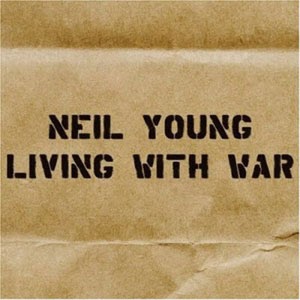
48. Living With War


48. Living With War, Neil Young (Reprise, 2006)

It was easy during the Aughts for even dedicated Neil Young fans to lose interest.  After his strong ’00 folk-rock outing Silver & Gold (see #75), Young released a stretch of work more ignominious than his much-maligned ’80s output.  The live Road Rock Vol. 1: Friends & Relatives (’00) was his fourth concert set in ten years, its arguable redundancy made worse by middling performances.  His long-awaited studio debut with Booker T. & the M.G.'s, Are You Passionate? (’02), was a passionless assortment of half-baked blues and painfully weak vocals; next came Greendale, a tedious 78-minute concept album short on melody that Young nonetheless felt warranted two separate editions.  During this parade of lackluster new material, Young waffled to the point of absurdity on his plans to release his long-promised Archives box set.  By the time the inoffensive but forgettable country-rock outing Prairie Wind arrived in ’05, NOYOUCMON had decided to retire from buying Neil Young albums.  Young’s next project proved so provocative, however, that even the most jaded fan was hard pressed to ignore it.  Angry to the point of despair about the seeming futility of the wars being fought in Afghanistan and Iraq, Young found inspiration in a newspaper article about in-flight surgery on military aircraft.  Within a matter of days, he’d written an album’s worth of material whose immediacy—in both speed of recording and in tone—made Living With War the most galvanizing example of music as news since Young recorded the song Ohio with Crosby, Stills & Nash not three weeks after the Kent State shootings in 1970.

The material’s sound hinges on aggressive, metallic guitar, making for Young’s most raucous LP since Mirror Ball, his ’95 collaboration with Pearl Jam.  Only bassist Rick Rosas and drummer Chad Cromwell accompany Young’s guitar on the core tracks (trumpeter Tommy Bray joins on two songs).  A week after recording, Young overdubbed a 100-voice choir on each song, amplifying the united-we-stand communal sentiment of the lyrical themes.  (Young released a separate edition of the album featuring the original unmixed tracks without the choir, titled Living With War—“In the Beginning.”)  The album is an unapologetic vivisection of the Bush administration and the mid-Aughts home-front climate; as shown in the ’08 tour film CSNY/Déjà Vu, its politics drove conservative fans to wish physical violence against Young.  The songs explicitly address the War on Terror, most famously in jaunty singalong Let’s Impeach the President with its strategic juxtaposing of self-contradictory soundbites from Bush speeches.  More than one song addresses Bush’s disingenuous ’03 “mission accomplished” speech.  Lookin’ for a Leader examines the possibilities for Bush’s replacement, presciently mentioning Obama nearly a year prior to his campaign announcement.  Angriest is The Restless Consumer, a gush of emotions from frustration with advertising fatigue and American ostentation versus Mideast poverty to post-9/11 fear and anxiety (“Don’t want no damned jihad/Blowin’ themselves away in my hood”) while suggesting that not all wartime problems are the enemy’s fault (“But we don’t talk to them/And we don’t learn from them”); each verse ends with a repeated chorus of “Don’t need no more lies.”  Those believing the album is anti-American need look no further than Families; its final chorus of “I just can’t wait to see you again in the USA” (recalling his ’80 song Hawks & Doves) is a declaration of the proud patriotism that Young, a longtime Canadian expatriate, feels for his adopted country.  While its subject matter ensures that many will never accept it as a valid artistic statement, Living With War was, after over five years of dwindling returns, much-desired testimony that Young’s creative well had not run dry.

Highlights: Families, The Restless Consumer, Lookin’ for a Leader, Let’s Impeach the President

Sublime bit: Young’s breathless indictment of pharmaceutical ads, jihadists, and flag-draped coffins in The Restless Consumer.

Read the NOYOUCMON mission statement here.

Wednesday, June 23, 2010

64. Two Against Nature


64. Two Against Nature, Steely Dan (Giant/Reprise, 2000)

It seemed nutty enough when, following some production collaborations, jazz-rock studio mavens Steely Dan regrouped for a ’93 concert tour to support frontman Donald Fagen’s then-current second solo LP Kamakiriad, playing their first shows since ’74 and making first use of the Dan name since their final (and weakest) album, the ’80 Gaucho.  The group, swollen with session players and dubbed “The Steely Dan Orchestra,” opened shows with a Muzak-style medley of Dan hits before easing into a set including tunes from Fagen’s and guitarist Walter Becker’s solo work.  This occasionally went beyond the sound of the group’s pristine, painstaking ’70s albums and into dullness, captured on the aseptic tour souvenir Alive in America (’95).*  Kamakiriad was a pale shadow of Fagen’s first solo effort, the excellent ’82 The Nightfly; and Becker’s debut solo turn, 11 Tracks of Whack (’94), is the abomination of the Dan cosmology.  Considering these inauspicious resurfacings, the notion of strong new Steely Dan product in the Aughts would have been a fool’s wager.  It would have been no stretch to imagine the routinely out-of-touch Grammys bestowing an award on the reunited pair, out of simple familiarity; it was one of the most shocking music-biz turns of the decade, then, when their 2000 reunion album Two Against Nature beat out hot items Eminem and Radiohead’s Kid A to win Album of the Year (and three other awards)—and actually deserve it.  For those who hadn’t heard the album, it was easy to presume this a Grammy blooper on the level of Jethro Tull’s notorious ’89 defeat of Metallica in the Hard Rock/Metal category; the reality, though, is that Two Against Nature is the best work from the Fagen/Becker camp since The Nightfly and the finest Steely Dan album since the 1977 classic Aja.

The reunion album’s main strength is its compositions.  Kamakiriad and Gaucho are both too heavy on forgettable numbers short on hooks, and their flawless studio craftsmanship and light-jazz habits push the lesser material into elevator-music territory.  Two Against Nature is impeccably played, courtesy of nearly thirty session musicians, yet its delivery is never dull.  The planning of a high-level prank in Gaslighting Abbie, the syncopated funk of the title track’s voodoo exorcism, and the exhilaration of an undoubtedly inappropriate romance in Almost Gothic provide compelling narratives.  Almost Gothic lends its enthralled narrator additional zing by giving each chorus a different lyric about the antagonist ingénue and an upward key change with each cycle.  The grind of everyday life punctuated by long-anticipated romantic moments dominates: What a Shame About Me finds an unfulfilled bookstore employee accidentally reconnecting with an old flame; in West of Hollywood the suburban narrator, whose regular life finds him “way deep into nothing special,” recalls “She reached out for my hand/While I watched myself lurch across the room.”  The naughty but good-natured romp Cousin Dupree scored its own Grammy songwriting award, though it does pale alongside its more nuanced companions here.  Steely Dan released only one more Aughts album, Everything Must Go (’03), yet toured for much of the decade focusing mainly on the classic ’70s material; two more solo LPs followed (Fagen’s ’06 Morph the Cat and Becker’s ’08 Circus Money, both improvements on their respective predecessors).  Each of these albums is adequate and will attract diehard fans; it is Two Against Nature, though, issued just two months into the decade, that holds up the best and delivers the finest material of the unexpected second incarnation of Steely Dan.

* I saw the group's Chicago-area gig in August 1993 and found it a largely soulless display of Dan-by-numbers.  Fagen explained in an interview at the time, when asked if playing his old songs stirred up any feelings, that he preferred to operate detachedly and with no emotional investment during the reunion gigs—if memory serves, he described his method as "laser thinking," though I can't track down the specific interview (which I recall as being in Musician magazine).  Steely Dan's press kits are awash with pranks and piss-takes, but even if this was another instance of intentional silliness it seemed to ring true during their initial comeback.

Highlights: Almost Gothic, Janie Runaway, Gaslighting Abbie, Two Against Nature

Sublime bit: Fagen’s delivery of Almost Gothic’s three different chorus lyrics, peaking at 3:15 with “First she’s all buzz/Then she’s noise-free.”
 
Read the NOYOUCMON mission statement here.

Sunday, May 16, 2010

75. Silver & Gold


75. Silver & Gold, Neil Young (Reprise, 2000)

When 2000 dawned, it had been over three years since the last Neil Young studio album--the longest gap of his 31-year solo career.  That record, the pleasingly disjointed ’96 Broken Arrow, came shortly after the death of Young’s friend and producer David Briggs; the two had worked together for 26 years.  A tour with Crazy Horse followed, along with the ’97 double-live Year of the Horse, as of this writing the last full release with his longtime backing band.*  He spent the rest of the ’90s working on two projects: Looking Forward, his first record with Crosby, Stills & Nash since ’88 and only their third studio LP since their ’70 debut; and his 25th solo album, Silver & Gold.  For his first Aughts release, Young returned to the acoustic stylings visited most recently on the ’92 Harvest Moon and several times before, most famously on his ’72 hit album HarvestHarvest loyalists tend to claim any country-leaning Young album as a sequel.  Emphasizing this suspicion for some is the appearance on Silver & Gold of the aforementioned albums’ steel guitarist Ben Keith and backup singer Linda Ronstadt; however, Ronstadt (along with fellow occasional Young collaborator Emmylou Harris) sings on only one song, Red Sun, and Keith’s return speaks not to a planned third part of Harvest but to Young’s tendency to keep a handful of backing bands that he rotates depending on the musical needs of his current project.  Another habit blurring his catalog’s lines is the return to old compositions when the time is right; for Silver & Gold, he revived a pair of unrecorded songs dating to ’82 (the title track) and ’84 (Razor Love), both of which he’d played live in the years since.**

The revisiting of songs almost twenty years old matches the album’s themes of reminiscing and reevaluation.  This is most explicit on Buffalo Springfield Again, the most upbeat number and a candid account of Young’s memories with that group in the late ’60s before their acrimonious breakup (“It ate us up/Now I ain’t sayin’ who was right or wrong”); hearing the group on the radio, Young imagines a reunion, stating “I’d just like to play for the fun we had.”  Parental love is addressed in two songs.  Daddy Went Walkin’ is a warm account of a father’s mundane activities and set of observations--the gathering of firewood, his corduroy pants and plaid shirt, riding in a car with a dog--concluding with an idealized depiction of the father’s love for the mother.  When not reminiscing, Young examines the solidification of existing relationships.  In Red Sun, Young’s narrator imagines a placid future with a lover, adding “I dreamt that my mama and daddy were there.”  Opening cut Good to See You describes reuniting with a lover, its title’s simple sentiment amplified by the deeper emotional resonance of a permanent homecoming.  Distant Camera asserts, “Life is changing everywhere I go/New things and old both disappear/If life is a photograph fading in the mirror/All I want is a song of love to sing to you.”  A line in Without Rings addressing communication failure--“My software’s not compatible with you”--was a howler in a pre-Web 2.0 society, yet resonates more keenly a decade later when so many relationships are mitigated online.  An ambling, amicable album, Silver & Gold was Young’s last strong release before a flaccid six-year stretch, a tender acknowledgment that love is our most precious asset.

* The 2003 album Greendale is credited to Neil Young and Crazy Horse, but does not include the entire group.  Crazy Horse guitarist Frank Sampedro did not participate due to Young's conclusion that the album required only one guitarist.

** Razor Love is shown on Silver & Gold credits as having a 1987 copyright date; bootleg recordings reveal performances of the song as early as 1984.

Highlights: Good to See You, Buffalo Springfield Again, Razor Love, Distant Camera

Sublime bit: The emotion in the verse endings of “I feel like I know what my life is for” and “I feel like making up for lost time” in Good to See You.
 
Read the NOYOUCMON mission statement here.