Wednesday, April 28, 2010

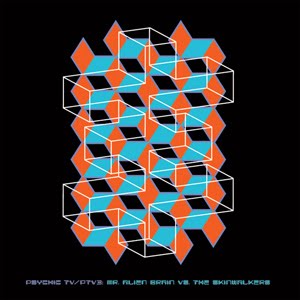
81. Mr. Alien Brain vs. the Skinwalkers


81. Mr. Alien Brain vs. the Skinwalkers, Psychic TV/PTV3 (CD version) (Sweet Nothing/Cargo, 2008)

Singular British eccentric artist and musician Genesis P-Orridge, born Neil Megson in 1950, worked in confrontational performance and visual art from the late ’60s, forming notorious industrial-music pioneers Throbbing Gristle in ’76.  They dissolved in ’81 and P-Orridge formed the less scandalous but still uncompromising Psychic TV.  During some thirty studio albums and even more live LPs, P-Orridge, the only constant member, charted a musical course ranging from acid house, ambient, and pop-oriented psychedelic music.  Deciding to move more toward spoken word material, P-Orridge disbanded the group in ’99.  In the mid-Aughts he returned to both outfits, reforming Throbbing Gristle a year after the ’03 reactivation of Psychic TV.  Sometimes using the moniker PTV3, the band issued the Hell Is Invisible...Heaven Is Her/e album in June ’07.  PTV3’s lineup included Lady Jaye Breyer, P-Orridge’s partner with whom he famously underwent a series of plastic surgeries to more closely resemble one another. This relationship would inform the bulk of P-Orridge’s work in the Aughts.

While preparing for an '07 US tour, Breyer died of stomach cancer complications.  The mourning P-Orridge withdrew from work obligations.  It was with some surprise, then, when Mr. Alien Brain vs. the Skinwalkers, the second PTV3 LP, appeared just over a year later.  While its predecessor is a garish, bloated orgy of psychedelic indulgence, Mr. Alien Brain is a disciplined collection not free of levity yet profoundly focused in its grief.  That said, the apparent desire to create a new album as a memorial to Breyer that included her own contributions means that it is derived from a hodgepodge of sources: a handful of new studio cuts, a remix of a song from Hell Is Invisible (New York Story) and a Breyer poem to P-Orridge that appeared on that album’s vinyl version (I’m Making a Mirror), and five songs recorded live in the studio for an uncharacteristic hour-long Psychic TV feature on National Public Radio’s World Cafe program.  It is these NPR recordings that provide the album’s most astonishing material; they are impeccable performances largely lacking the usual rough edges of radio sessions, especially a gripping ten-minute straightforward rock ’n’ roll cover of the Velvet Underground’s Foggy Notion.  The most compelling piece, though, is a cover of Syd Barrett’s No Good Trying.  It begins with a 45-second loop of a disturbing sample from Barrett’s 1970 LP The Madcap Laughs finding him nervously failing to hit a note and asking to start the song again.  P-Orridge’s masterful repurposing of this uncomfortable moment sets a watchful tone for the album.  Original tunes Trussed, The Alien Brain, and Pickles and Jam further explore dark moods; along with Foggy Notion, a new performance of the poppy, joyous ’86 Psychic TV b-side Papal Breakdance and the closing I Love You, I Know--a playful Breyer/P-Orridge dialogue reminiscent of the ’69 Lennon/Ono Wedding Album--provide happy emotional relief.  The vinyl issue has a different track listing, omitting a song and adding an incongruous side of concert material and a Monks cover that already appeared on the ’06 Silver Monk Time tribute LP; the CD version is stronger. It is an intense, resolute album, sometimes peculiar in its choices, and perhaps the finest recording of P-Orridge’s lengthy and storied career.

Highlights: No Good Trying, Papal Breakdance, Foggy Notion, Trussed

Sublime bit: Foggy Notion’s rock ’n’ roll absolution, peaking at 6:38 after an extended bridge with a blissful “Whoooo!” as the band kicks back in.

Read the NOYOUCMON mission statement here.

Monday, April 26, 2010

82. Sun Giant


82. Sun Giant (EP), Fleet Foxes (Sub Pop, 2008)

The acclaimed full-length debut by Seattle folk-rock quintet Fleet Foxes was preceded by the nineteen-minute Sun Giant EP.  Released digitally and as a tour souvenir in February ’08, the five-song work received an official physical U.S. release in April of that year just two months before the Fleet Foxes long player hit the shelves.  Appearing so close together, the two recordings came to be seen as companion pieces: Sub Pop’s vinyl edition of Fleet Foxes included a bonus 12” of Sun Giant; the overseas market received a two-disc “special edition” of the records (but using the full-length’s cover art); and Pitchfork named the conjoined works the best album of 2008 (though, it should be noted, the magazine originally reviewed them separately).  Even the band blurred the lines between Sun Giant and Fleet Foxes, as a single from Sun Giant (the EP’s highlight, Mykonos) was released nearly a year after the full-length was released.  All of this inter-record miscegenation makes sense, for both releases capture the young band at the beginning of a rise to critical acclaim unusual for a group at the time of its debut album.  The band toured to rapturous response--particularly in the UK--and earned rhapsodic reviews in the music press; in its July 2008 issue, UK magazine MOJO hailed the full-length as an “instant classic,” giving it five stars.  The album is an impressive achievement (see #95); song for song, though, taken on its own the Sun Giant EP is an even more distinguished release. The strengths of Sun Giant are attributable in part, perhaps, to its chronology. Though predating the album by a season on the release schedule, it was recorded a few months after the full-length.  It avoids, then, the introductory jitters and tentativeness sometimes natural for debut EPs; that was reserved for the group’s regionally released eponymous EP, sold on tour and in the Seattle area in late ’06 and long since discounted from the official Fleet Foxes discography.

Like the full-length, Sun Giant opens with an a capella piece.  While on Fleet Foxes the unadorned singing was just a fragment, the EP’s first song is almost composed almost entirely of unaccompanied vocal harmonies.  “What a life I lead in the summer/What a life I lead in the spring,” it begins, echoing the naïf wonderment demonstrated by the wide-eyed philosophical ruminations in the liner notes of the band’s ’08 releases.  Its 46-second coda of quietly finger-picked guitar and distant humming gives way to Drops in the River, a Sun Giant highlight that illustrates the band’s ability to create a booming, powerful sound without relying on volume or bombast.  The musical accompaniment low in the mix, including the drums whose parts seem reduced to floor toms and quietly crashing cymbals, the song’s brawn comes from the reverb-drenched harmonies that are the hallmark of the ’08-model Fleet Foxes.  The record’s centerpiece, Mykonos, possesses its boldest arrangement; Pecknold, his voice here husky and reminiscent of Bruce Springsteen, sings lead; only on the song’s extended coda do his bandmates join him on harmonies.  Nature is, as on the full-length, a lyrical theme; winter turns meadows brown, leaves are strewn on window frames, and snow covers treetops.  The aforementioned two-disc edition of this material appends one song to Sun Giant, the Mykonos b-side and traditional British ballad False Knight on the Road; it fits well stylistically with the group’s original material, but as the only cover in their catalog to date it does sit better in its first home as a flip side.  However the music is packaged, Sun Giant is a striking set of songs as worthy of consideration as its more famous full-length relative.

Highlights: Mykonos, Drops in the River, English House, Sun Giant

Sublime bit: The climax of Mykonos, from 2:25 to 3:23, starting with an understated drum fill before swelling with the EP’s strongest harmonies.
 
Read the NOYOUCMON mission statement here.

Saturday, April 24, 2010

83. Natural


83. Natural, Mekons (Quarterstick, 2007)

For a time in the mid-Aughts, it was easy to think that the Mekons, veterans of the late-’70s Leeds punk scene, had fallen silent for good.  The majority of the band kept busy with other projects, and scattered across the globe (with a preponderance living in Chicago at one point or another) they had few chances to work as a cohesive unit.  The ’04 LP Punk Rock, comprising re-recordings of Mekons tunes from ’77-’81, seemed a self-issued eulogy.  Years passed with no full group live appearances.  There was no record-company turmoil keeping them from recording as in years past.  The arrival of Natural, then, was a relief to those in the cult of the group’s endearingly ramshackle live performances and literate yet pragmatically informal milieu.  The sassy militancy of their earliest work long gone, Aughts-model Mekons kept the rough-hewn melangé of guitar-bass-drums and violin-bouzouki-cümbüs harvested since their ’80s entrée to country and roots music while departing further from the rowdy energy of their ’90s work, nostalgic back-catalog visits notwithstanding.

Natural is, described lazily, an acoustic album; more accurately, though, it is a “natural” album.  The band’s ’00 effort Journey to the End of the Night (see #104) featured songs of apprehension and worry played very softly.  Natural is no mere wheedly-dee unplugged outing, and is often as worrisome in its subjects and more noisy in its execution as Journey.  Where that album’s dread spawned from the complicated vagaries of modern life, Natural is concerned with more earthy matters.  The Mekons tradition of peppering the inner sleeve with quotations, narratives, and historical trivia returns; while on Journey they pertained to tales of the grim urban underworld, Natural utilizes the likes of Charles Darwin, Scopes “Monkey” trial commentator H. L. Mencken, seventh-century astronomers, and geological talk and discussion of ancient stone formations.  The material world is generally met with suspicion; the Tom Greenhalgh-sung Zeroes and Ones, the album’s most aggressive track, describes ominously a world where reliance on technology leaves us “Strangers in nature/Aliens from god,” the alienating aspects of perpetual connectivity and accessibility leaving us “Lost forever, never lost.”  The sparse, hushed tune The Old Fox is a delicately pretty depiction of foxes walking over ice and searching for food in dustbins, their habitats bleeding into human society.  “Conditions are difficult/And full of responsibility,” we are told, as the voices of Greenhalgh, Jon Langford, and Sally Timms intertwine, trading gently overlapping vocal lines.  “It is good to collect things, but it is better to go on walks,” reads a quote from poet Anatole France; the Langford-sung Cockermouth embraces this spirit, its narrator rambling through the countryside.  “Jet fighters swooping loud and low/Rehearse for Armageddon,” but the protagonist gleefully sheds his clothes, conjures Thoreau, and gets lost on purpose.  “We used to dance/Around the stone head/It used to sing to us,” sings Langford in the haunting closing track Perfect Mirror, reprising a theme from the ’02 LP OOOH! (Out of Our Heads)Natural knows that the temporal and the synthetic are forever mingled, the significance of antiquities such as stone heads permanently muted, but reminds us that it will always be beneficial to take walks and get lost.

Highlights: The Old Fox, Shocking Curse Bird, Diamonds, Zeroes and Ones

Sublime bit: The impassioned plea, after ten largely muted and reserved songs, of the group vocal on “Planets swirl, bodies entwine/I can’t hear you, you’re cutting out” at 1:53 of the album’s penultimate track, Zeroes and Ones.

Read the NOYOUCMON mission statement here.

Tuesday, April 20, 2010

84. Coles Corner


84. Coles Corner, Richard Hawley (Mute, 2005)

The son of working-class Sheffield musicians, Richard Hawley grew up playing guitar and toured with bar bands by age fourteen.  In the mid-’80s he played with Treebound Story, an indie-pop quartet reminiscent of Echo and the Bunnymen who recorded a handful of EPs and a Peel Session yet never managed to complete their debut LP.  The bulk of the group, including Hawley, then spent a stint as the Lovebirds; shortly thereafter, he joined local outfit Longpigs, with whom he had his first pronounced success outside of the region.  A relatively undistinguished Britpop group, they nonetheless earned significant commercial success in the UK before disbanding in ’99 after two albums.  Hawley’s next gig was as touring guitarist for fellow Sheffield mainstays Pulp.  Upon hearing some Hawley solo demos, Pulp singer Jarvis Cocker and bassist Steve Mackey encouraged him to pursue them further; the result was Hawley’s ’01 eponymous debut EP.  Hawley would go on to release five full-lengths in the Aughts.  After over fifteen years of dutiful guitar work in other people’s groups, it seemed unlikely that Hawley would make a convincing frontman; more unexpected, though, was Hawley’s knack for writing lush, romantic ballads informed as much by post-war British popular music as by early rock and roll and country-and-western troubadours and delivered in a resonant croon that recalls not just Elvis Presley but pop vocal giants like Nat “King” Cole and Frank Sinatra.  Hawley’s music is also reminiscent of Nick Lowe’s Aughts work (see #103 and #117); Hawley’s luxuriant approach, though, transcends the tight, minimal techniques of Lowe’s romantic soul music.

For Hawley’s fourth solo release, Coles Corner, he gained his first appreciable distribution deal, with Mute Records, after the dissolution of his previous label, Setanta.  Like most of his Aughts works, the album is named for a real location in his beloved Sheffield; in this case, for a famed meeting place for blind dates.  The songs depict courtships truncated, interrupted, and unrequited.  The title track opens the album majestically with a lavish introduction by a seven-piece string section.  “I’m going downtown where there’s music/I’m going where voices fill the air/Maybe there’s someone waiting for me,” sings Hawley.  This loneliness continues on tracks like I Sleep Alone and Tonight; in the latter, he sings “Maybe I should call her/Ah, but then she’ll know.”  Hotel Room finds a couple acting as surrogate lovers, its narrator singing, “It’s time I met someone like you.”  The album’s finest piece is The Ocean, its orchestral swell accompanied by a towering, impassioned Hawley vocal.  Much of the album recalls ’50s-era vocal crooners; Hawley’s love for early British rock shows through, though, including the light skiffle beat of Just Like the Rain and I Sleep Alone.  Hotel Room features a swoon-inducing Hawaiian lap steel solo.  The album closes with a murmured take on the traditional number Who’s Gonna Shoe Your Pretty Little Feet? and the late-night instrumental Last Orders, a piano piece that bleeds slowly into layers of ambient hum as if to wash away the pain of heartache.  The sentimental snapshots of Coles Corner make for Hawley’s first great record.

Highlights: The Ocean, Coles Corner, Just Like the Rain, Hotel Room

Sublime bit: The last 2:45 of The Ocean, beginning with Hawley’s final chorus that kicks in at 2:51.

Read the NOYOUCMON mission statement here.

Friday, April 16, 2010

85. Black Sea


85. Black Sea, Fennesz (CD version) (Touch UK, 2008)

Austrian guitarist and laptop composer Christian Fennesz was the Aughts’ leading practitioner of ambient and electro-acoustic improvisation, releasing three primary albums during the decade* and a dozen more records in collaboration with other artists ranging from electronic mainstay and Yellow Magic Orchestra keyboardist Ryuichi Sakamoto to alt-rock songwriter/guitarist Mark Linkous of Sparklehorse.  Fennesz’s solo material, beginning with ’95 debut EP Instrument, consists of challenging instrumental pieces combining melodic structures with drones, static, and glitch techniques that rely on choppy, discordant noises approximating the sounds of damaged equipment, short circuits, and other aberrations (the song Before I Leave on his ’01 LP Endless Summer, for example, sounds almost entirely like a skipping compact disc).  In ’99 he released the two-song single Fennesz Plays featuring his interpretations of the Rolling Stones’ Paint It Black and the Beach Boys’ Don’t Talk (Put Your Head on My Shoulder), the purported cover versions so unrecognizable that royalty-controlling agents allegedly determined the original artists’ writing credits to be unnecessary.  Other artists use these compositional methods in abrasive, confrontational manners, such as the jagged, grating eruptions of UK duo Autechre whose seemingly impenetrable glitch opus Quaristice was released the same year as Fennesz’s fourth solo album Black Sea.  Fennesz utilizes them in more understated ways, often as an accompaniment to his effects-laden guitar or as one element in a set of layered sonic accents.  This is music devoid of rhythm, melodic only occasionally and in the sparsest sense.  From his first full-length, the ’97 Hotel Paral.lel [sic], to Black Sea, his final album of the Aughts, his music grew progressively nuanced and calm.

The music of Black Sea is as desolate as the winter vista on its cover.  The first two minutes of the ten-minute opening title track contain the album’s harshest sounds; a squall of static and industrial clamor brings to mind the noise of a shipyard before giving way to a gentle acoustic guitar pattern at the three-minute mark.  Slowly, the guitar is met by an undercurrent of gurgling static suggesting the rolling waves of the sea.  Two of the album’s finest pieces feature guests: The Colour of Three, with pianist Anthony Pateras, features walls of Fennesz’s treated electric guitar, forming abruptly like an electric charge before dissipating slowly over a bed of Pateras’s prepared piano that sounds like deep bells pealing in slow motion.  The album’s centerpiece, Glide, features labelmate Rosy Parlane, with whom Fennesz released a joint single in 2000; recorded live, the nine-minute piece opens with a sound like distant wind blowing; echoing, erratic percussive accents create tension before the first hints of melodic progression begin near the piece’s fourth minute, taking six minutes to build to a crescendo before fading glacially to silence.  Black Sea, like all good ambient music, rewards its patient listeners with immense beauty, and its author is the premier ambient musician of the decade.

NOTE: The vinyl version, which has different cover art, omits The Colour of Three and another tune, Vacuum; as such, it is not recommended.

* His second solo album, Plus Forty Seven Degrees 56' 37" Minus Sixteen Degrees 51' 08", is often said to be a 2000 release; however, its original release, in a limited-edition slipcover, came in 1999, with the 2000 issue being its second pressing in a regular jewel case.

Highlights: Glide, The Colour of Three, Black Sea, Saffron Revolution

Sublime bit: At 5:50 of Glide a single, high-pitched tone rings out; it is subtle, but marks the piece’s climax and the beginning of its fade to silence.

Read the NOYOUCMON mission statement here.